Identifying Disinformation Conference
24 April | University of Malta Library
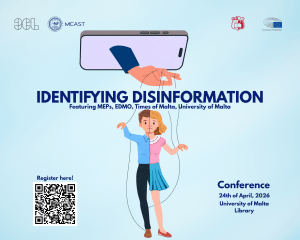
Disinformation is a structural feature of the contemporary information environment, shaping public discourse, trust, and democratic processes. As digital platforms accelerate the spread of content, the ability to critically assess information has become an essential civic skill.
On Friday, 24th of April 2026, from 9:00-14:00, the 3CL Foundation, in collaboration with the European Parliament Liaison Office in Malta, the University of Malta, and MCAST, will host a half-day conference at the University of Malta Library.
The conference brings together MEPs, policymakers, academics, and media professionals to explore how disinformation is produced, disseminated, and encountered across different contexts. It places particular emphasis on practical approaches to identifying misleading content, understanding its mechanisms, and strengthening individual and institutional resilience.
Through a combination of expert panels and interactive sessions, participants will engage with both the theoretical foundations and applied dimensions of disinformation. Discussions will address how persuasive techniques are embedded in digital content, how local information ecosystems shape exposure, and how citizens can develop tools to critically evaluate information in real time.
Conference agenda
08:45 – 09:00
Arrival and Registration
09:00 – 09:15
Opening Remarks
Dr Mario Sammut, Head of the European Parliament Liaison Office In Malta
Prof Godfrey Baldacchino, University of Malta and 3CL Foundation
09:15 – 09:45
Disinformation and the EU
A representative of the European Parliament’s administration will discuss a set of case studies and give an overview of EU action against disinformation.
Ms Angelika Pentsi, Press Officer, Spokesperson’s and Information Integrity Unit, EP Brussels
09:45 – 10:40
Panel 1: How Is Disinformation Designed to Influence Us?
This session explores common persuasion tactics such as exaggerated language, selective presentation of facts, and emotional triggers, including anger, fear and outrage, that can cloud judgment. Recognising these techniques is key to identifying disinformation.
Dr Paula Gori, European Digital Media Observatory (EDMO), Italy
Prof Alex Grech, University of Malta & 3CL Foundation
Dr Francois Zammit, University of Malta
Dr Lucianne Zammit, University of Malta
10:40 – 10:55
Coffee Break
10:55 – 11:50
Panel 2: Understanding Disinformation in Malta
What practical steps can we take to verify information locally? This session examines how to verify the authenticity of a source, trace the origins of images and video, and cross-reference stories against trusted outlets. The panel will demonstrate how to spot the warning signs that content may not be what it claims to be.
Dr Mark Bugeja, University of Malta
Mr Herman Grech, Times of Malta and MedDMO
Prof Gorg Mallia, University of Malta and MedDMO
Prof Carmen Sammut, University of Malta
11:50 – 12:30
Developing a Disinformation Identification Checklist
Participants will work in groups to develop a practical checklist for identifying disinformation, drawing on the tools and techniques explored throughout the morning sessions. Groups will then present their findings to the wider audience.
12:30 – 13:00
Networking Lunch
13:00 – 14:00
Encountering Disinformation as an MEP
Members of the European Parliament will share their first-hand experiences of encountering disinformation in their roles and discuss its impact on democratic processes. The session will be followed by an extended Q&A on the European Parliament and disinformation.
MEP Alex Agius Saliba, MEP Peter Agius
The conference is moderated by the 3CL. A short Q&A will follow each panel and the session with the MEPs.
Conference close.

